
ProductsThe beneficiation ladder.
The first rung sits inside the aggregates operation itself. Polished Stone Value aggregate is the skid-resistant, high-specification material used in road surfacing, runways and structural concrete — and splitting a single fraction into a standard and a high-specification grade is where the margin sits, for material coming off the same circuit.
Whether this granodiorite makes PSV specification is untested. It is the single largest swing factor in the economics, it is a testable question rather than an assumption, and establishing the answer is the cheapest decisive item in our entire work programme.
Shape is a product specification, not a by-product
Two loads of the same rock, crushed differently, are not the same product. Particle shape decides how the aggregate packs, and packing decides how much cement paste the mix has to buy to fill the space between the stones.
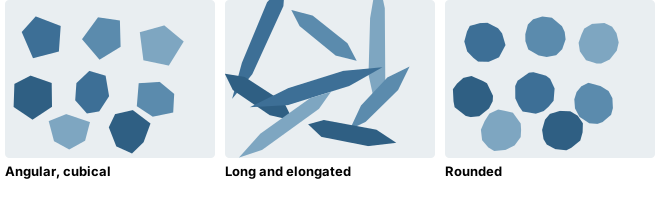
What we are aiming to produce
Dense packing and mechanical interlock. Less void space to fill, so less paste, so less cement per cubic metre for the same strength.
The common local product
Sharp slivers bridge and lock against each other, leaving voids the mix designer must fill with paste. Flaky and elongated particles also carry weak planes that fracture under load.
Flows, but does not grip
River-worn material places easily and interlocks poorly — lower strength for the same mix, and unusable where skid resistance is specified.
Where the crushing circuit reduces flakiness, the customer's cement bill goes down. That is a saving in their mix design, not a discount off our tonne rate — which is why it is worth engineering for.
The order of magnitude is not small. A published mix design that optimised the aggregate skeleton for packing took cement from 500 kg/m³ to 350 kg/m³ — a 30% reduction — by getting free space in the mineral skeleton down to 17% and topping the binder up with fly ash, while still passing 68 MPa at 90 days. We are not claiming that number for a rock nobody has drilled. We are saying which lever it sits on.
Where it pays: self-compacting concrete
Self-compacting concrete is placed without vibration — it has to flow into the form, around congested reinforcement, and level itself. Tarmac's Topflow is the specification to read: designed to BS 8500, 10 mm or 20 mm coarse aggregate depending on application, up to 25% recycled aggregate, slump flow classes SF1 (550–650 mm) and SF2 (660–750 mm), 35–50 N/mm² at 28 days, DC-3 chemical class.
None of that is achievable on badly shaped stone. Flow is governed more by the macro-shape of the coarse aggregate than by fine angularity, and long elongated particles bridge and block exactly where a self-compacting mix must not. A quarry that cannot supply cubical aggregate is locked out of the highest-value concrete lines before the conversation starts.
Stated as observation, not as measurement
Our reading of the Harare supply picture is that most producers ship long, elongated, sharp-edged material and that Davis Granite is the exception. That is trade observation, not a flakiness index we have run in a laboratory — and our own rock is undrilled, so nothing here is a claim about what our product will test at. Both are questions for the work programme, and both are cheap to answer.
Planned processing lines
Three value-add lines sit on top of the aggregates operation. None of them exists yet. They are roadmap, and we state them as roadmap.
Polished architectural stone
Cladding and high-end finishes — the same rock sold into architecture rather than tonnage.
Ready-mix concrete
Structural concrete delivered to site. Moves the business from supplying the builder to supplying the build.
Architectural concrete
Coloured and textured design-grade finishes — a specification product rather than a bulk one.